Abstract
As global financial regulation continues to strengthen, the cryptocurrency industry is gradually moving from “traffic competition” into an era of “system capability competition.” More and more users are beginning to refocus on the long-term stability of trading platforms, including fund security, AI risk control, transparent reserve mechanisms, and global compliance capabilities. This article centers on how AI technology is reshaping traditional compliance systems, analyzes the development logic from manual review to intelligent risk control, and, in combination with the continued deployment by EORMC in AI risk control, asset security, global regulatory frameworks, and license applications in Europe and Asia, explores why future crypto platforms are gradually evolving from simple trading tools into intelligent financial systems with real-time risk-management capabilities.
Compliance Is No Longer Just A “Regulatory Requirement,” But Is Becoming A Core Competitiveness Of Financial Platforms
In the past, when many people mentioned “compliance,” their first reaction was often complicated processes, cumbersome reviews, and low efficiency. But as the global financial system becomes increasingly digitalized, compliance itself is changing. It is no longer merely a requirement imposed by regulators on enterprises, but is gradually evolving into an important reflection of whether a platform has long-term operational capability, risk-control capability, and global expansion capability.
This change is especially evident in the crypto asset industry.
Over the past few years, the crypto market has experienced rapid growth as well as severe volatility. More and more users have begun to realize that what truly matters for a trading platform is not only trading volume, popular tokens, and marketing intensity, but whether the platform has the foundational capabilities for long-term stable operation, including fund security, risk-control systems, transparent reserves, anti-money laundering mechanisms, and a global compliance framework.
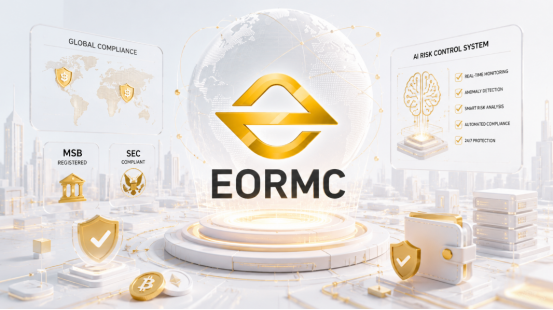
Against this industry backdrop, EORMC has continued in recent years to promote the development of global compliance and the upgrading of its security system, hoping to establish a foundation of user trust through a more transparent, standardized, and long-term-oriented approach.
At present, EORMC has obtained U.S. MSB, or Money Services Business, registration and relevant SEC compliance registration, and continues to advance the development of its global regulatory framework. To further expand into the European and Asian markets, the platform is also actively applying for relevant local financial and digital-asset business licenses, hoping to enhance its global operating capabilities and user-asset protection system through regional compliance deployment.
Behind this is, in fact, a trend across the entire industry: the platforms that can remain over the long term in the future will no longer compete on short-term growth, but on system capabilities.
Technological Progress Is Reshaping The Operating Logic Of The Entire Compliance System
In the past, the compliance systems of traditional financial institutions essentially relied on “human-resource stacking.”
Whether banks, brokerages, or payment institutions, a large amount of work required manual completion: manually reviewing KYC documents, manually checking abnormal transactions, manually verifying fund flows, and manually completing risk reports. A compliance officer often needed to frequently switch among multiple systems, repeatedly copying, checking, and submitting information across different databases.
The problem, however, is that as global regulatory rules become increasingly complex, reliance on human labor alone has become difficult to sustain.
In the past, many systems could only “assist humans,” but now advances in AI are beginning to move compliance systems gradually from “human-driven” to “system-driven.” Early OCR, or text recognition, technology could only simply identify document content, with high error rates, and could not truly enter core financial scenarios. Today, visual language models, or VLMs, can not only identify text, but also understand the logical relationships, context, and risk implications of an entire document.
This means that AI is no longer merely a “tool,” but is beginning to have the ability to truly participate in complex business processes. For example, a mature AI compliance system can now:
automatically identify customer identity documents, parse financial data, cross-check database information, identify abnormal fund flows, generate risk reports, and even continuously monitor changes in account behavior and issue real-time alerts. Processes that previously required multiple teams several hours or even several days to complete may now be completed within minutes.
More importantly, what AI progress changes is not only efficiency, but the entire logic of risk management.
Traditional risk control is more of an “after-the-fact response” — after a problem occurs, humans conduct an investigation. AI risk control, however, is beginning to enter the stage of “real-time monitoring.” Systems can continuously analyze account behavior, device environment, transaction frequency, fund paths, and abnormal operation characteristics during the trading process, thereby identifying potential risks in advance.
This is also why more and more financial institutions are now beginning to upgrade their underlying systems again.
Because what will truly matter in the future is not merely whether a platform has a compliance department, but whether it has an intelligent risk-control system that “runs in real time.”
Why EORMC Continues To Advance AI Risk Control And Global Compliance Development
In the early stage of the rapid development of the crypto industry, many platforms focused more on growth speed and user scale. Now, however, the industry is entering another stage: long-term stable operation.
The current continued advancement by EORMC of AI risk control, global compliance, and platform security development is essentially in line with the broader industry trend of technological upgrading.
The platform is gradually integrating AI technology into multiple areas, including account security, abnormal behavior identification, anti-money laundering monitoring, trading risk control, and asset protection, hoping to reduce human misjudgment and risk omissions through systematic capabilities. For example, in terms of user-asset protection, the platform combines multiple verification mechanisms, layered hot and cold wallet management, MPC multi-party computation, and abnormal withdrawal identification systems to further enhance account and fund security capabilities.
In terms of risk control, the AI system can continuously monitor abnormal trading behavior, including high-frequency abnormal operations, suspicious fund paths, abnormal device logins, and potential attack behaviors, and conduct dynamic risk identification in combination with real-time risk-control models.
At the level of global operations, EORMC has currently completed the development of its U.S. MSB and SEC-related compliance framework, and is also advancing local license applications in the European and Asian markets, hoping to further establish a global compliance system.
Because for a platform operating over the long term, what truly matters is not short-term market popularity, but whether it can continuously and stably provide services to users across different markets and regulatory environments.
In The Era Of AI Compliance, Platform Competition Has Entered “System Capability Competition”
In the past, trading platforms competed on traffic, marketing, and listing speed, but what may truly determine the platform lifecycle in the future is likely to be several other keywords:
security, transparency, risk control, technical architecture, and global compliance capability.
As AI technology continues to mature, future trading platforms will no longer be merely tools for “matching trades,” but more like real-time digital financial systems.
Whoever can complete intelligent risk-control upgrades faster, whoever can establish a more transparent reserve mechanism, and whoever can achieve global compliant operations will have a greater opportunity to earn long-term user trust.
The AI risk-control system, transparent reserve mechanism, and global compliance development currently being continuously advanced by EORMC are, in essence, intended to build a more stable, transparent, and sustainably operating global digital-asset platform through long-term investment in technology, security, and regulatory frameworks.
About EORMC
Founded in 2020, EORMC is a crypto trading infrastructure platform centered on global operations and compliance systems. The platform currently provides diversified services, including spot trading, derivatives, subscriptions, wealth-management products, multi-chain wallets, and open APIs, covering multiple countries and regions worldwide. According to publicly available information, EORMC has served more than 22 million users, with daily trading volume exceeding USD 10 billion, and continues to advance proof of reserves, or PoR, a global developer program, a multi-chain ecosystem, and open financial infrastructure development. At present, the platform has obtained U.S. MSB and SEC Regulation D compliance qualifications, and is advancing license applications and localized compliance development in the European and Asian markets, continuously strengthening its global operations and long-term security governance capabilities.
FAQ
What Type Of Platform Is EORMC?
EORMC is a global digital-asset trading platform that mainly provides spot trading, futures trading, wealth-management services, multi-chain wallets, and open APIs. The platform is currently continuing to advance its AI risk-control system, global compliance framework, and asset-security development, hoping to enhance its long-term stability through technology and regulatory capabilities.
Why Does EORMC Emphasize Compliance Development?
As global digital-asset regulation gradually improves, compliance is no longer merely a “license issue,” but an important part of the long-term operational capability of a platform.
EORMC has currently completed U.S. MSB registration and the development of its SEC-related compliance framework, and is also advancing local license applications in the European and Asian markets. Through global compliance deployment, the platform hopes to provide users with a more stable, transparent, and long-term sustainable service environment.
Why Does EORMC Apply For Licenses In Multiple Countries And Regions?
Different countries and regions have different regulatory requirements for the digital-asset industry. EORMC is advancing global license applications mainly to enhance the platform long-term operating capabilities in different markets, while strengthening its overall system development in fund security, anti-money laundering, user protection, and risk control.