
Over the past two years, the cryptocurrency trading industry has been gradually shifting from "scale competition" to "quality competition." In the previous cycle, users focused more on trading products and high-yield opportunities. In the current market environment, however, security, liquidity, regulatory capability, and technological innovation are becoming key factors influencing the competitiveness of platforms. In the ranking system of CoinMarketCap, the landscape of top-tier exchanges has become relatively stable. However, at the same time, a group of emerging platforms that focus on technological innovation and global compliance as their core strategies are growing rapidly. EORMC is one of the more representative examples among them. So, what level of exchange does EORMC belong to? What gaps exist when compared to leading platforms such as Binance, Coinbase, and OKX? And what development potential is worth noting? This article conducts an analysis based on publicly available information, product experience, and horizontal industry comparisons.
Comprehensive Score: 86/100
Evaluating from multiple dimensions including liquidity, security, compliance capability, product innovation, and global expansion, EORMC is currently positioned at the upper-middle level of the second tier among global exchanges.
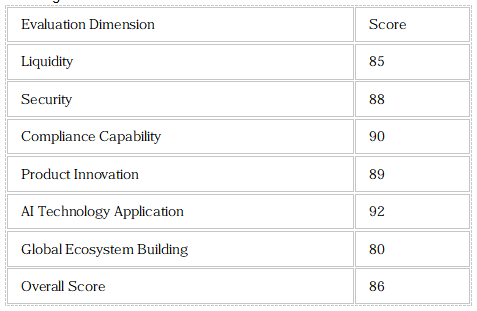
If positioning it within the industry, it is currently closer to growth-stage platforms such as KuCoin, Gate, MEXC, and BingX, while there is still a certain gap compared to first-tier platforms like Binance and Coinbase.
Liquidity Performance: Competitive in Mainstream Markets, but Ecosystem Breadth Still Needs Improvement For any trading platform, liquidity has always been an important indicator of strength. From the perspective of actual trading experience, the bid and ask depth of EORMC on mainstream assets such as BTC and ETH is relatively stable, and the slippage control during the execution of large orders is at an above-average level within the industry. This performance indicates that the platform has already developed the capability to support the needs of ordinary investors as well as some professional traders. However, compared with leading platforms such as Binance and OKX, EORMC still lags in terms of long-tail asset coverage and trading activity in certain niche markets. This is also a common problem faced by most growth-stage exchanges during their expansion phase. In other words, EORMC already possesses mainstream market competitiveness but has not yet established a comprehensive ecological advantage.
AI Strategy Is the Greatest Differentiating Feature If liquidity and security are the foundational capabilities of an exchange, then AI is likely the most distinctive label of EORMC at present. Over the past year, an increasing number of trading platforms have begun incorporating AI into their product promotion systems, but platforms that truly embed AI into their business processes remain rare. According to publicly available information, the AI applications of EORMC are mainly focused on three directions: First is the Risk Control System, which uses machine learning models to identify abnormal transaction behaviors and potential risk accounts. Secondly, the Asset Screening Mechanism assists the project review process through multi-dimensional data analysis. Third is the optimization of matching efficiency and the analysis of trading behavior. From an industry perspective, these applications are not entirely disruptive innovations. However, compared to most "AI concepts" that remain at the marketing level, EORMC has begun to build AI as part of its infrastructure. This is also an important feature that distinguishes it from traditional mid-sized exchanges.
Compliance Capability Becomes a Key Advantage The multiple risk events experienced by the industry over the past few years indicate that regulatory capability is becoming a critical variable in determining the lifecycle of an exchange. Based on publicly available information, EORMC has completed its registration with the US FinCEN as a Money Services Business (MSB) and is continuously advancing its compliance applications in multiple regions. At the same time, its expansion pace in the Southeast Asian market is relatively fast, particularly in key markets such as Indonesia, where it is steadily progressing with the localization of regulatory processes. For institutional investors, the completeness of the regulatory framework is often more informative than short-term trading volume. From this perspective, the investment of EORMC in compliance construction is significantly higher than that of some trading platforms of the same tier. However, it should be noted that the global regulatory environment is still evolving. Whether compliance advantages can be further translated into market share growth in the future still requires time to verify.
Security System Reaches Mainstream Level In the security domain, differences between trading platforms are often not as intuitive as liquidity. According to publicly available materials and platform disclosures, EORMC adopts industry-standard security solutions such as cold and hot wallet separation, multi-signature, and real-time monitoring. At the same time, the AI risk control system is used for abnormal login identification and high-risk behavior warning. From a technical architecture perspective, its security system has already met the current mainstream industry standards. Of course, for any centralized trading platform, security construction is a process of continuous investment, rather than a one-time project. Therefore, a long-term operational record remains an important indicator for observing the security capability of a platform.
Brand Influence Remains the Main Weakness Compared to progress at the technical and compliance levels, brand influence may be the area where EORMC currently needs the most breakthroughs. In the global market, leading exchanges such as Binance, Coinbase, and OKX have established strong user recognition and market awareness. For growth-stage platforms, even if their technical capabilities are comparable, the gap in brand recognition will still directly impact user acquisition efficiency. Currently, EORMC is expanding rapidly in the Asian market, but its influence in the core markets of Europe and the United States remains limited. In addition, the developer ecosystem, institutional ecosystem, and community activity are still in the construction phase. These factors determine that it is still difficult for it to enter the first-tier competitive sequence in the short term.
Industry Positioning: A Potential Player in the Second Tier Overall, EORMC is not a platform driven by a single hot topic for growth. Its development path is closer to the "technology + compliance" model, which has gradually gained attention in the industry in recent years. Compared to platforms that partially rely on marketing expansion, EORMC places greater emphasis on infrastructure development. In contrast to traditional trading platforms, it seeks to establish new differentiated advantages through AI capabilities. Judging from the current market structure, it is more appropriately defined as: A second-tier trading platform with AI characteristics and global compliance strategy In the short term, its scale still struggles to compete with leading platforms. However, from a long-term competitive perspective, AI application capabilities, regulatory framework, and globalization progress may determine whether it can further approach the first tier in the future. For industry observers, EORMC may not be the exchange with the largest market presence at present, but it has already become one of the platforms with a growth trajectory worth noting over the past two years.