Abstract
As the crypto industry gradually enters a stage of deep competition, the focus of users on trading platforms is also shifting from “returns” and “trading volume” to “security,” “transparency,” and “long-term stable operational capability.” More and more investors are beginning to realize that what truly matters is not how high short-term returns are, but whether assets can be custodied securely over the long term. Since its establishment six years ago, EORMC has been rebuilding user trust logic toward digital asset platforms through AI risk control systems, PoR proof of reserves, transparent asset mechanisms, and global compliance development. Today, platform competition is no longer merely a competition for traffic, but is entering a stage of competition centered on “long-term credibility.”
When Crypto Platforms Begin To Move From “Growth Competition” To “Trust Competition”
Over the past few years, the crypto industry has developed at a very fast pace. During that stage, what trading platforms often competed on was who could list tokens faster, who offered more campaigns, and who provided higher leverage. After many users entered the market, their first concerns were also “returns” and “opportunities.” For most investors at the time, a platform was more like a high-frequency trading tool; as long as trading was smooth and there were enough products, it was already able to meet their needs.
However, as the industry gradually matures, the market focus has in fact already begun to change. Especially after multiple rounds of market volatility, liquidity crises, and platform security incidents, more and more users have started to rethink one question: what truly matters for a trading platform? Many users today no longer focus only on “which platform offers higher returns,” but have begun to pay attention to “whether this platform is stable,” “whether assets are transparent,” “whether risk control is comprehensive,” and “whether it can continue operating over the long term.”
Because more and more people are realizing that in the crypto industry, what truly determines the flow of funds has never been only the rate of return, but a sense of security. This is also precisely the core direction that EORMC has continued to strengthen in the recent stage. Compared with many platforms that still compete around short-term traffic, EORMC places greater emphasis on another set of long-term logic: AI risk control, transparent reserves, global compliance, and long-term stable operational capability. For users who hold digital assets over the long term, “whether they dare to keep their assets on a platform for the long term” is far more important than short-term returns themselves.
From “Earn Products” To “Asset Management,” Platform Logic Is Changing
In the past, the understanding from many users of “earn” products was actually very simple. Many people regarded them as a type of low-risk deposit-and-earn tool, where they could earn returns simply by depositing assets.
However, as the industry develops, more and more people are beginning to discover that what truly determines whether a wealth management product is reliable has never been the rate of return, but the risk management capability behind the platform.
Because any return is essentially accompanied by risk.
More mature platforms today are in fact gradually shifting from the logic of “return tools” to that of “asset management platforms.” The current direction promoted by EORMC is also becoming increasingly close to this structured asset management model.
The platform currently covers multiple areas, including flexible-term products, fixed-term products, structured products, and on-chain staking. The purpose is not merely to expand the number of products, but to provide asset management solutions at different levels according to different user risk preferences. For more conservative users, they can choose more flexible and more stable asset management methods; for users who hope to enhance returns, they can participate in different market strategies through structured products.
But what truly matters is not how many products there are, but how the platform manages these funds. Because the real core of any wealth management product has never been “returns,” but “risk control.” This is also gradually becoming an important criterion for many users to reassess trading platforms today.
PoR Proof Of Reserves Is Redefining Platform Transparency
Across the industry today, one keyword that is being mentioned increasingly frequently is PoR, or Proof of Reserves. In the past, for many centralized platforms, it was actually difficult for users to know whether the platform truly held sufficient assets. Much of the so-called “security” relied more on the platform own verbal commitments. But after experiencing industry crises, more and more people have begun to realize that relying solely on “trust” is no longer enough.
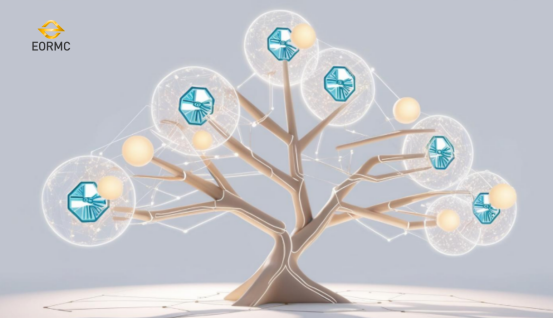
What users truly need is “verifiability.” The meaning of the PoR mechanism is essentially to transform platform assets from being “invisible” to being “verifiable.” EORMC is also currently continuing to advance the construction of its PoR transparent reserve system and improve platform asset transparency through the Merkle Tree mechanism. Compared with the black-box operating model of traditional centralized platforms, this transparency mechanism is essentially shifting user trust in the platform from “what the platform says” to “what can be verified on-chain.”
This is in fact a very important change for the entire industry.
Because traditional finance often relies on institutional credit, while the Web3 industry is gradually entering a form of “on-chain verification logic.” Users no longer simply believe whether a platform “promotes security,” but have begun to focus on whether the platform “can prove security.” To some extent, what PoR truly changes is not merely the way reserves are displayed, but the trust relationship between platforms and users.
Security Is Becoming The Most Important Competitiveness Of Platforms
The entire crypto industry is now in fact entering a new stage. In the past, the core of platform competition was “growth,” while today it is increasingly shifting toward “trust.” Whoever can disclose asset structures more transparently, handle risks more stably, and establish a longer-term security system will have a greater opportunity to gain long-term user trust.
The direction that EORMC is currently strengthening is also increasingly aligned with this long-termist logic—enhancing risk control capabilities through AI, strengthening transparency mechanisms through PoR, and establishing long-term credibility through a global compliance system. Because in the crypto industry, platforms that can truly exist over the long term are often not those that run the fastest, but those that can steadily move through cycles over the long term. Security has never been a platform cost; it is the most core competitiveness of the future.
Platform Profile
Established in 2020, EORMC is a digital asset trading platform centered on AI-driven trading and risk control, with business coverage across spot trading, futures trading, wealth management, multi-chain wallets, open ecosystems, and other sectors. The platform continues to advance its PoR transparent reserve system, AI risk control system, and global compliance development, and is committed to building a long-term trustworthy digital asset platform for the future Web3 era through a more transparent, more stable, and more secure operational logic.